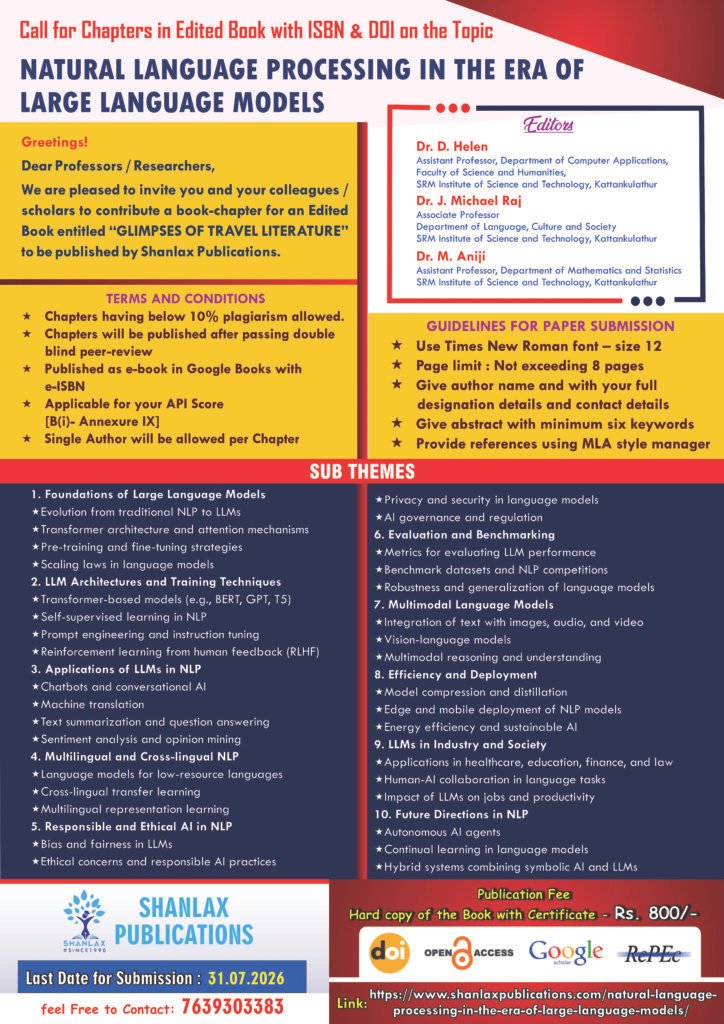

Call for Chapters in Edited Book with ISBN on ‘Natural Language Processing in the Era of Large Language Models’
Natural Language Processing in the Era of Large Language Models explores how modern AI systems have transformed the field of Natural Language Processing through the development of powerful Large Language Models such as GPT and BERT. The book explains how these models are trained on massive datasets to understand, generate, and interact with human language more effectively than traditional methods. It covers key topics like transformers, deep learning architectures, text generation, sentiment analysis, and real-world applications including chatbots, translation, and content creation. Emphasizing both opportunities and challenges, the book also discusses ethical concerns, bias, and the future of human-AI interaction, making it a valuable resource for students, researchers, and professionals interested in modern language technologies.
Editors
Dr. D. Helen, Assistant Professo, Department of Computer Applications, Faculty of Science and Humanities, SRM Institute of Science and Technology, Kattankulathur
Dr. J. Michael Raj, Associate Professor, Department of Language, Culture and Society, SRM Institute of Science and Technology, Kattankulathur
Dr. M. Aniji, Assistant Professor, Department of Mathematics and Statistics, SRM Institute of Science and Technology, Kattankulathur
Sub-Themes
1. Foundations of Large Language Models
☆ Evolution from traditional NLP to LLMs
☆ Transformer architecture and attention mechanisms
☆ Pre-training and fine-tuning strategies
☆ Scaling laws in language models
3. Applications of LLMs in NLP
☆ Chatbots and conversational AI
☆ Machine translation
☆ Text summarization and question answering
☆ Sentiment analysis and opinion mining
5. Responsible and Ethical AI in NLP
☆ Bias and fairness in LLMs
☆ Ethical concerns and responsible AI practices
7. Multimodal Language Models
☆ Integration of text with images, audio, and video
☆ Vision-language models
☆ Multimodal reasoning and understanding
9. LLMs in Industry and Society
☆ Applications in healthcare, education, finance, and law
☆ Human-AI collaboration in language tasks
☆ Impact of LLMs on jobs and productivity
2. LLM Architectures and Training Techniques
☆ Transformer-based models (e.g., BERT, GPT, T5)
☆ Self-supervised learning in NLP
☆ Prompt engineering and instruction tuning
☆ Technology and Financial Literacy
☆ Reinforcement learning from human feedback (RLHF)
4. Multilingual and Cross-lingual NLP
☆ Language models for low-resource languages
☆ Cross-lingual transfer learning
☆ Multilingual representation learning
6. Evaluation and Benchmarking
☆ Metrics for evaluating LLM performance
☆ Benchmark datasets and NLP competitions
☆ Robustness and generalization of language models
8. Efficiency and Deployment
☆ Model compression and distillation
☆ Edge and mobile deployment of NLP models
☆ Energy efficiency and sustainable AI
10. Future Directions in NLP
☆ Autonomous AI agents
☆ Continual learning in language models
☆ Hybrid systems combining symbolic AI and LLMs
Terms and Conditions
⇨ Chapters having below 10% plagiarism allowed.
⇨ Chapters will be published after passing double blind peer-review
⇨ Published as e-book in Google Books with e-ISBN
⇨ Applicable for your API Score [B(i)- Annexure IX]
⇨ Single Author will be allowed per Chapter
Important Dates
⇨ Last Date for Submisson: 31.07.2026
Guidelines for Paper Submission
⇨ Use Times New Roman font – size 12
⇨ Page limit : Not exceeding 8 pages
⇨ Give author name and with your full designation details and contact details
⇨ Give abstract with minimum six keywords
⇨ Provide references using MLA style manager
Publication Fee
⇨ Hard copy of the Book with Certificate – Rs. 800/-
Chapter Submission