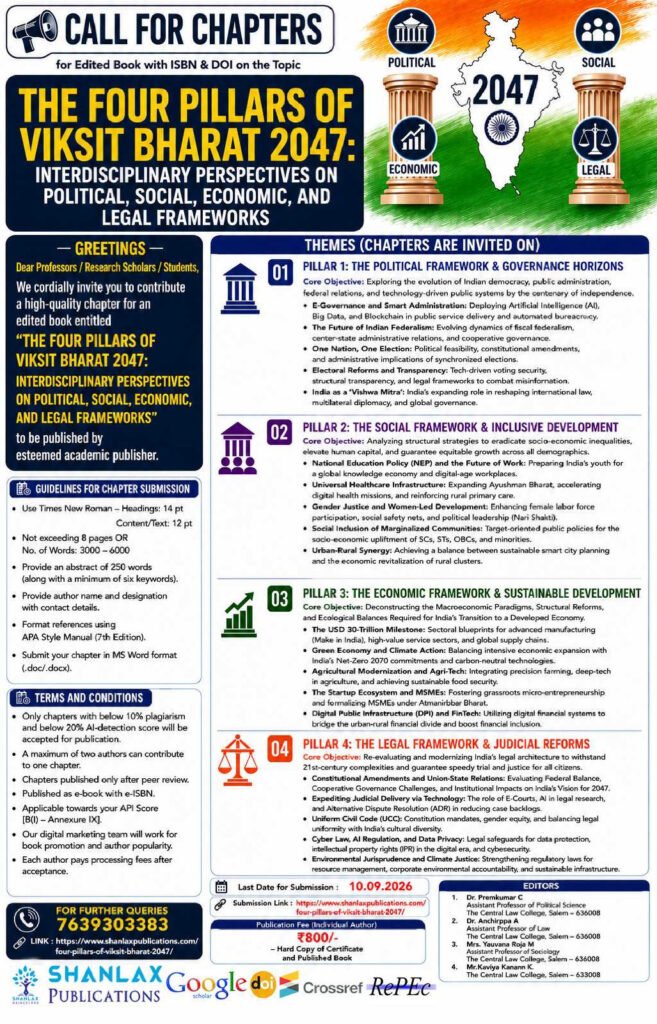

Call for Chapters in Edited Book with ISBN & DOI on ‘The Four Pillars of Viksit Bharat 2047: Interdisciplinary Perspectives on Political, Social, Economic, and Legal Frameworks’
The Four Pillars of Viksit Bharat 2047: Interdisciplinary Perspectives on Political, Social, Economic, and Legal Frameworks. This book explores the vision of Viksit Bharat 2047 through interdisciplinary perspectives on political, social, economic, and legal systems. It examines the policies, reforms, and innovations required to build an inclusive, sustainable, and globally competitive India. The chapters provide critical insights into governance, social transformation, economic development, and legal frameworks that support national progress. This volume serves as a valuable resource for researchers, academicians, policymakers, and students.
This edited volume presents a comprehensive understanding of the four foundational pillars of Viksit Bharat 2047-political governance, social development, economic growth, and legal reforms. Bringing together diverse interdisciplinary perspectives, it highlights contemporary challenges, emerging opportunities, and innovative solutions for achieving India’s long-term development goals. The book encourages critical discussion on public policy, inclusive development, institutional transformation, and sustainable progress. It is an essential reference for academicians, researchers, policymakers, professionals, and students interested in shaping the future of a developed India.
Editors
Dr. Premkumar C, Assistant Professor in Political Science, The Central Law College, Salem
Dr. Anchirppa A, Assistant Professor in Law, The Central Law College, Salem
Yauvana roja M, Assistant Professor in Sociology, The Central Law College, Salem
Kaviya Kannan K, Assistant Professor in Law, The Central Law College, Salem
Sub-themes
Pillar 1: The Political Framework & Governance Horizons
☆ E-Governance and Smart Administration: Deploying Artificial Intelligence (AI), Big Data, and Blockchain in public service delivery and automated bureaucracy.
☆ The Future of Indian Federalism: Evolving dynamics of fiscal federalism, center-state administrative relations, and cooperative governance.
☆ One Nation, One Election: Political feasibility, constitutional amendments, and administrative implications of synchronized elections.
☆ Electoral Reforms and Transparency: Tech-driven voting security, structural transparency, and legal frameworks to combat misinformation.
☆ India as a ‘Vishwa Mitra’: India’s expanding role in reshaping international law, multilateral diplomacy, and global governance.
Pillar 2: The Social Framework & Inclusive Development
☆ National Education Policy (NEP) and the Future of Work: Preparing India’s youth for a global knowledge economy and digital-age workplaces.
☆ Universal Healthcare Infrastructure: Expanding Ayushman Bharat, accelerating digital health missions, and reinforcing rural primary care.
☆ Gender Justice and Women-Led Development: Enhancing female labor force participation, social safety nets, and political leadership (Nari Shakti).
☆ Social Inclusion of Marginalized Communities: Target-oriented public policies for the socio-economic upliftment of SCs, STs, OBCs, and minorities.
☆ Urban-Rural Synergy: Achieving a balance between sustainable smart city planning and the economic revitalization of rural clusters.
Pillar 3: The Economic Framework & Sustainable Development
☆ The USD 30-Trillion Milestone: Sectoral blueprints for advanced manufacturing (Make in India), high-value service sectors, and global supply chains.
☆ Green Economy and Climate Action: Balancing intensive economic expansion with India’s Net-Zero 2070 commitments and carbon-neutral technologies.
☆ Agricultural Modernization and Agri-Tech: Integrating precision farming, deep-tech in agriculture, and achieving sustainable food security.
☆ The Startup Ecosystem and MSMEs: Fostering grassroots micro-entrepreneurship and formalizing MSMEs under Atmanirbhar Bharat.
☆ Digital Public Infrastructure (DPI) and FinTech: Utilizing digital financial systems to bridge the urban-rural financial divide and boost financial inclusion.
Pillar 4: The Legal Framework & Judicial Reforms
☆ Constitutional Amendments and Union-State Relations: Evaluating Federal Balance, Cooperative Governance Challenges, and Institutional Impacts on India’s Vision for 2047.
☆ Expediting Judicial Delivery via Technology: The role of E-Courts, AI in legal research, and Alternative Dispute Resolution (ADR) in reducing case backlogs.
☆ Uniform Civil Code (UCC): Constitutional mandates, gender equity, and balancing legal uniformity with India’s cultural diversity.
☆ Cyber Law, AI Regulation, and Data Privacy: Legal safeguards for data protection, intellectual property rights (IPR) in the digital era, and cybersecurity.
☆ Environmental Jurisprudence and Climate Justice: Strengthening regulatory laws for resource management, corporate environmental accountability, and sustainable infrastructure.
Guidelines for Paper Submission
⇨ Use Times New Roman font – Heading size: 14, Text size: 12
⇨ Not exceeding 8 Pages or no.of.words: 3000-6000
⇨ Provide an abstract of 250 Words (along with a minimum of six keywords)
⇨ Provide author name & designation with contact details
⇨ Format references using APA style manual
⇨ Submit your chapters in MS Word format (.doc/.docx)
Terms and Conditions
⇨ Only Chapters with below 10% plagiarism and below 20% AI detection Score will accepted for publication
⇨ A maximum of two authors can contribute to one chapter
⇨ Chapters published only after peer review
⇨ Published as e-book with e-ISBN
⇨ Applicable for your API Score [B(I)]-Annexure [X]
⇨ Our digital marketing team will work for book promotion and author popularity
⇨ Each author must pays processing fees after the acceptance
Publication Fee (Each Author pay)
⇨ For Indian Authors – 800 INR (Certificate & Physcial Copy)
⇨ For Foreign Authors – 20 USD (E-Certificate & E-Book)
Important Dates
⇨ Last Date for Submisson: 10.09.2026
Contact
⇨ For Further Queries: 7639303383